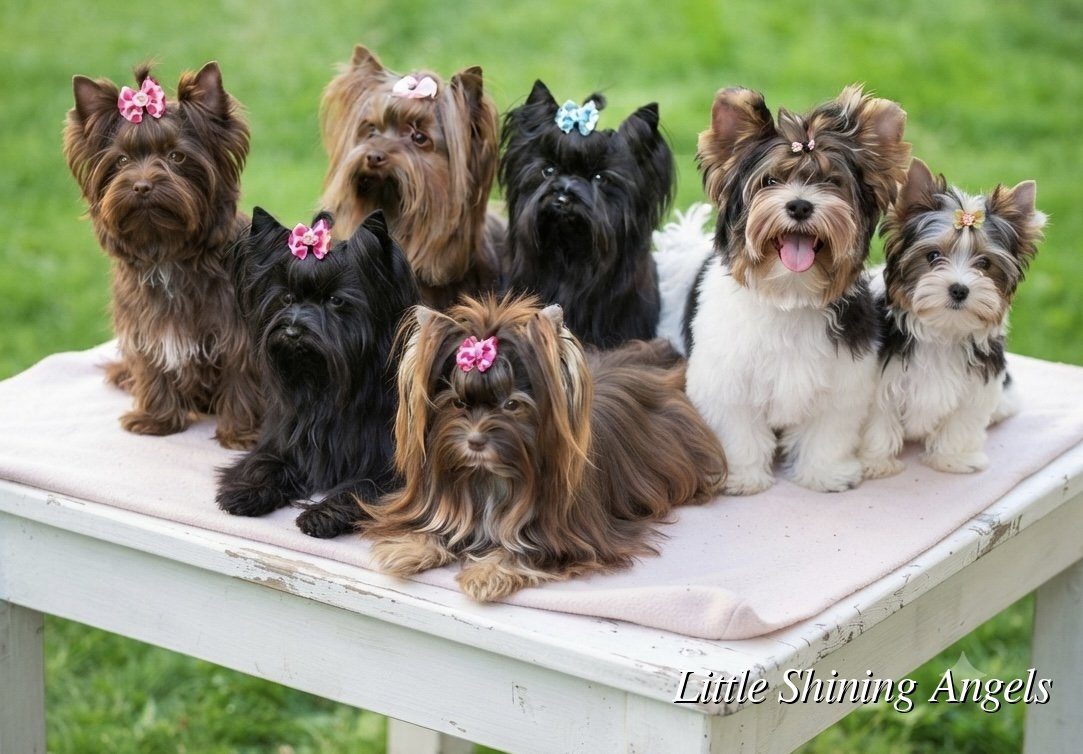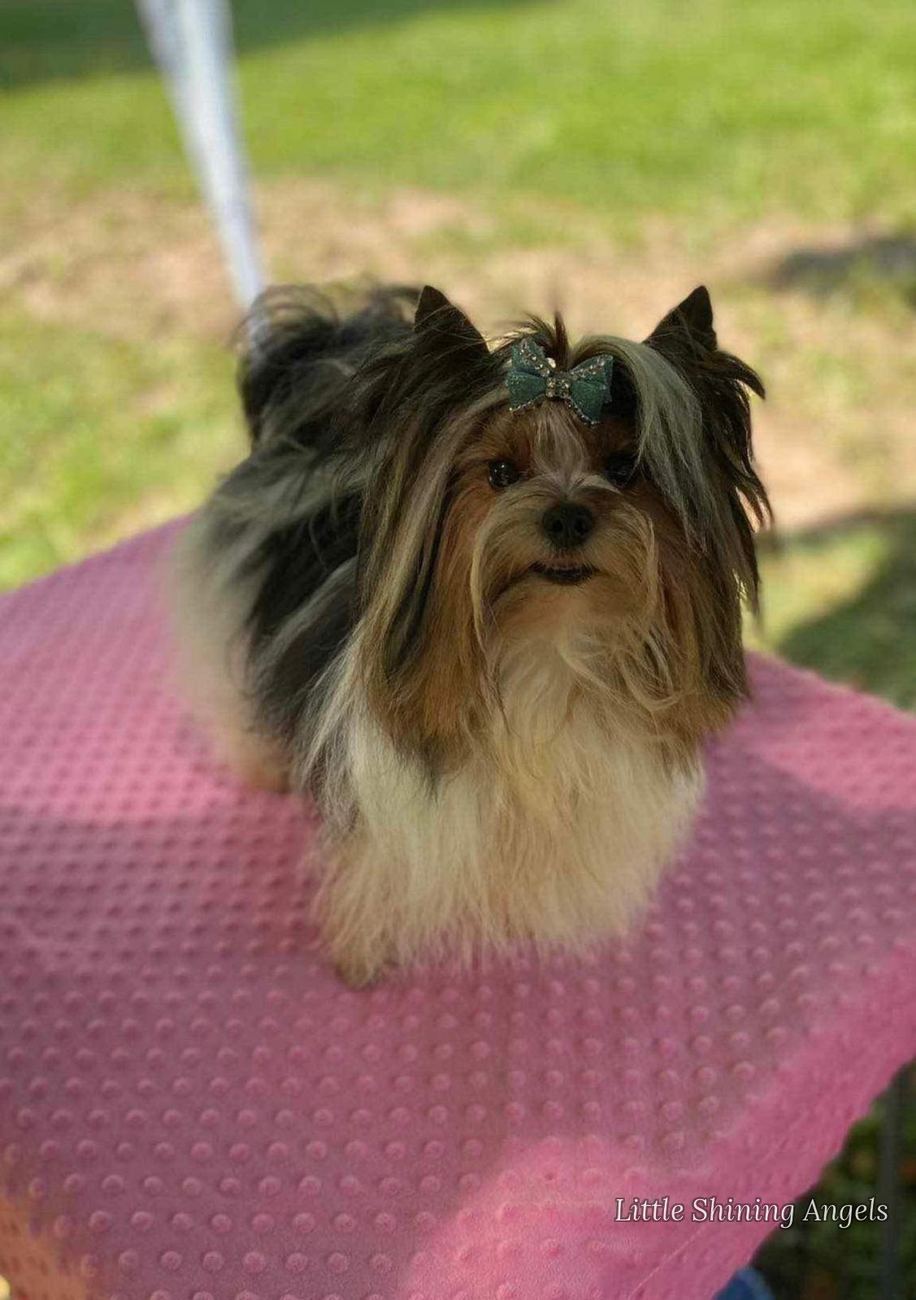
The history of the Biewer Terrier is usually told as a charming story about one unusual puppy. The story is true, but it is considerably more complicated than most summaries suggest. Comparing the sources, I found that they contradict one another in several places, and that one claim circulating online is simply not correct. So I decided to write the history as it is: stating where each fact comes from, and admitting openly where we have no answer.
1984: the puppy that should not have existed
Werner and Gertrude Biewer were experienced Terrier breeders. When their bitch Fru-Fru von Friedheck whelped a litter sired by Darling von Friedheck, one puppy was blue, white and gold. Both parents were first-class blue and tan Terriers, and their previous litters had never produced a tricolour puppy.
At the time the breeders could not have known that the puppy they named Schneeflöckchen, meaning Snowflake, was the result of both parents carrying the recessive allele for white spotting, known in the literature as piebald. This allele lies at the S locus and is caused by variants of the MITF gene, which governs pigment distribution. Under the standard, such colouring was a disqualifying fault; white markings in a Terrier under the FCI standard are a fault that excludes a dog from breeding.
And this is where the part that moves me most begins: the Biewers did not choose to hide the puppy. They chose to make something of their own from it.
Where the sources disagree
This is the part you will not find elsewhere, because most sources simply repeat one another.
How many tricolour puppies were there? The American breed club states that two tricolour puppies were born in 1984. National Purebred Dog Day writes that Snowflake was the only one of four puppies with the unusual colouring. A third source states that the first was born in early 1984 and another three months later. These are probably two different litters, but none of the sources says so explicitly.
When was the breed first imported to America? The club gives 2002, the American Kennel Club gives 2003. Gayle Pruett, co-founder of the breed in the United States, brought in her first Biewer in 2004. Some sources name Donna Hall as the first importer.
Who coined the name "à la Pom Pon"? All sources agree the name is connected with the German singer Margot Eskens. The club states that she added the words to the breed's name after taking a liking to the dogs. A Ukrainian breeding source tells a more colourful version in which her husband presented a puppy to her on a platter during dinner and she exclaimed "à la Pom Pon", French for a colourful ball of yarn. The version is charming, but only one commercial source reports it. I therefore give it here as an anecdote, not as fact.
Rejection at home
The path was not easy. According to one source, Werner Biewer first presented his tricolour dogs publicly in March 1988 in Wiesbaden, and the German kennel union rejected them, marking them as dogs of the wrong colour, not intended for breeding.
The criticism was harsh and lasted decades. The dogs were called designer dogs and their owners were mocked. The American Kennel Club initially rejected recognition applications, stating that it would not recognise as a breed dogs that were merely a colour variant of an existing breed. Similar attitudes prevailed in Europe.
There were also accusations of crossing with the Shih Tzu or the Maltese. German breeders firmly rejected these claims with anatomical arguments: had a Shih Tzu been involved, body structure, head shape and ear carriage would all have changed.
The genetic study that changed everything
In 2007 something happened that cynology had not seen before.
Members of the American club approached Dr Paul Jones of the Mars Veterinary laboratory with the question of whether the Biewer was genetically distinct from the Terrier. In September 2007 the laboratory received ten blood samples. The results showed the samples clustering in a way typical of a pure breed, but separately from the Terrier, so further and more varied samples were submitted. By October 2009 the laboratory had identified genetic markers for the Biewer Terrier after testing more than thirty lineages and over a hundred dogs.
The findings were interesting. Biewer Terriers share most of their haplotypes with Terriers, while chromosome 20 matches the Terrier less well. The closest breed at that location is the Havanese, with other breeds of the Bichon family also close. The tricolour itself is associated with the MITF gene, which governs pigment distribution.
This was the first time a breed was confirmed as purebred through the collection of genetic material rather than through pedigree records.
What other sources leave out
Here I must be honest, because otherwise this account would be one-sided.
The study was not published in a peer-reviewed scientific journal. It is available as a technical report published by the breed club itself. That does not make it wrong, but it does mean it did not undergo independent scientific review as published research does.
The test manufacturer itself notes the limitations. The Wisdom Panel FAQ states that the tests are neither designed nor intended to determine or validate whether a particular dog is purebred. Dr Angela Hughes of Mars Veterinary also noted that a small match to the Terrier should not disqualify a dog as a Biewer, since the Terrier is the base breed.
This caused a dispute within the breed. In 2018 a petition supported by 1,112 people demanded that the Mars Wisdom Panel test no longer be required for registration, arguing that the science was being applied in a way it was not designed for and was excluding dogs from the gene pool.
Why do I write this? Because I believe we do not defend a breed by concealing its weak points. We defend it by telling the whole story and letting the reader judge.
Recognition: what is actually true
After a renewed application, this time supported by the genetic findings, the American Kennel Club accepted the Biewer Terrier into its Foundation Stock Service in 2014. After progressing through that programme and the Miscellaneous class, the breed achieved full recognition on 1 January 2021 and the right to compete in the Toy Group. It became the 197th breed recognised by the club.
Since May 2024 the Biewer Terrier has also been recognised by the German kennel association VDH. It was recognised as a national breed, placed in FCI Group 3, with standard number 990, while it is explicitly stated that the breed is not recognised by the FCI.
And now the important part. A claim circulates online that the Fédération Cynologique Internationale also recognised the Biewer Terrier in 2024. This claim is not correct and stems from a misreading of the German recognition. The German VDH recognised the breed in May 2024, forty years after its creation; the FCI has not yet recognised it.
The difference is not trivial. National recognition means the breed may compete and be registered within an individual country. FCI recognition would mean validity across all member countries.
What this means here
In Slovenia the Biewer Terrier is entered in the studbook as a non-recognised breed, because the FCI does not yet recognise it. This does not mean a dog is not purebred or has no documented origin. It means only that the international federation has not completed the recognition process.
The breed's history shows such processes do move. The German recognition in 2024 is a step that could open the path to the FCI. But until that happens, the honest thing is to say how matters stand.
A final thought
The history of the Biewer Terrier is the story of two people who did not discard a puppy that, by the rules, should not have existed. It is also the story of how genetics decided a breed's fate for the first time in the history of cynology, and of how divided we can be about anything new.
That is precisely why this breed is close to my heart. It came from something that had been labelled a fault.
Literature and sources
Biewer Terrier Club of America. Biewer Terrier History. biewerterrierclubofamerica.org/biewer-terrier-history/ (accessed 19 July 2026).
Biewer Terrier Club of America. Biewer Terrier Data Analysis Project (technical report on the Mars Veterinary genetic analysis). biewerterrierclubofamerica.org/biewer-terrier-data-analysis-project/ (accessed 19 July 2026).
National Purebred Dog Day. The Biewer Terrier and the Power of DNA, 29 June 2025. nationalpurebreddogday.com/the-biewer-terrier-and-the-power-of-dna/ (accessed 19 July 2026).
Melody Rain Kennel. History of the Biewer breed. en.biewerkennel.tilda.ws/history_eng (accessed 19 July 2026). A commercial breeding source; its claims about the 1988 Wiesbaden show and the origin of the name are not independently confirmed.
American Kennel Club. Meet the Biewer Terrier: Newest 2021 AKC-Recognized Breed. akc.org (accessed 19 July 2026).
American Kennel Club. Biewer Terrier — Dog Breed Information. akc.org/dog-breeds/biewer-terrier/ (accessed 19 July 2026).
Verband für das Deutsche Hundewesen (VDH). Rasselexikon: Biewer Terrier. welpen.vdh.de (accessed 19 July 2026).
Verband Deutscher Kleinhundezüchter e.V. Der Biewer — nationale Rasse. States: FCI Group 3, standard no. 990, breed not recognised by the FCI. kleinhunde.de/biewer.php (accessed 19 July 2026).
Biewer World. Biewer Terrier MARS Study — Data Analysis Project Update. biewerworld.com (accessed 19 July 2026).
Change.org. Biewer Terrier Registration without Breed Detection (MARS Test) Requirement, 2018 petition with 1,112 signatures (accessed 19 July 2026).
Veterinary Genetics Laboratory, UC Davis. Genetic Diversity Testing for Biewer. vgl.ucdavis.edu/canine-genetic-diversity/biewer (accessed 19 July 2026).
Wikipedia. Biewer Terrier (used only for cross-checking dates; accessed 19 July 2026).
Note on reliability: statements about AKC and VDH recognition come from those organisations' official sources. Details about the birth of the first puppies and the origin of the name come from breed and breeder sources that partly contradict one another; those disagreements are flagged explicitly in the text.
This text is based on current professional knowledge and on our kennel's experience. It does not replace consultation with a veterinarian or cynologist.