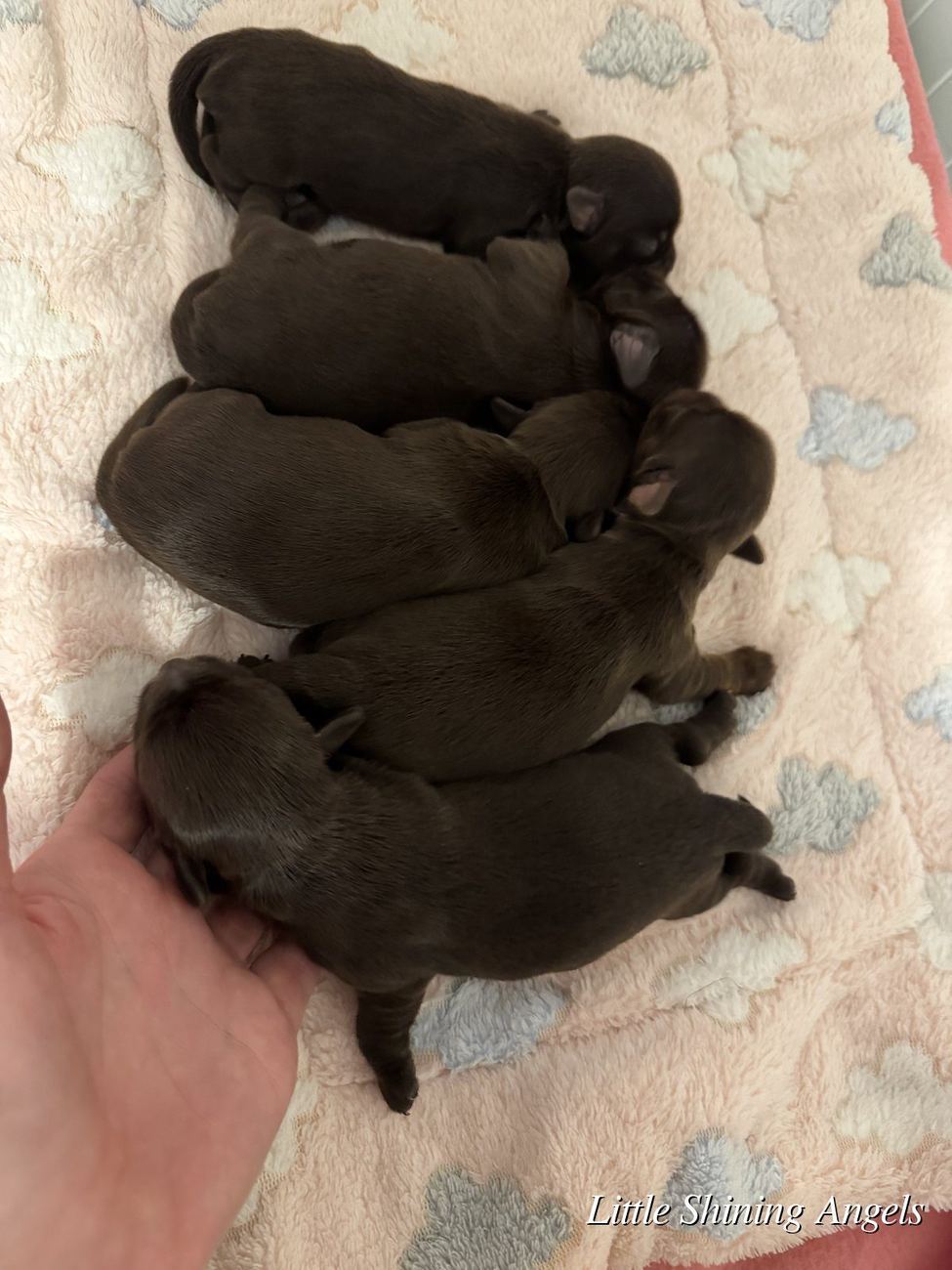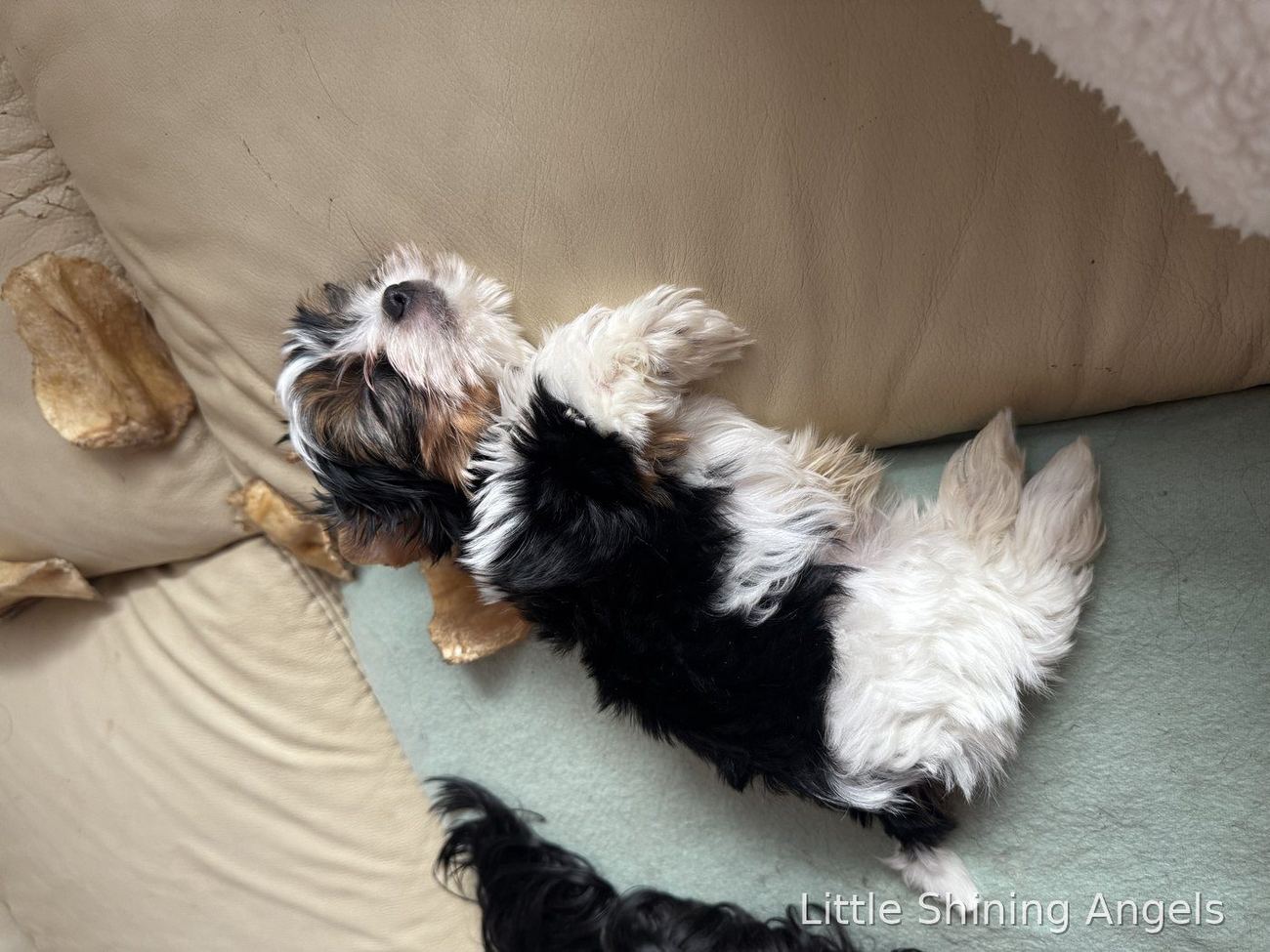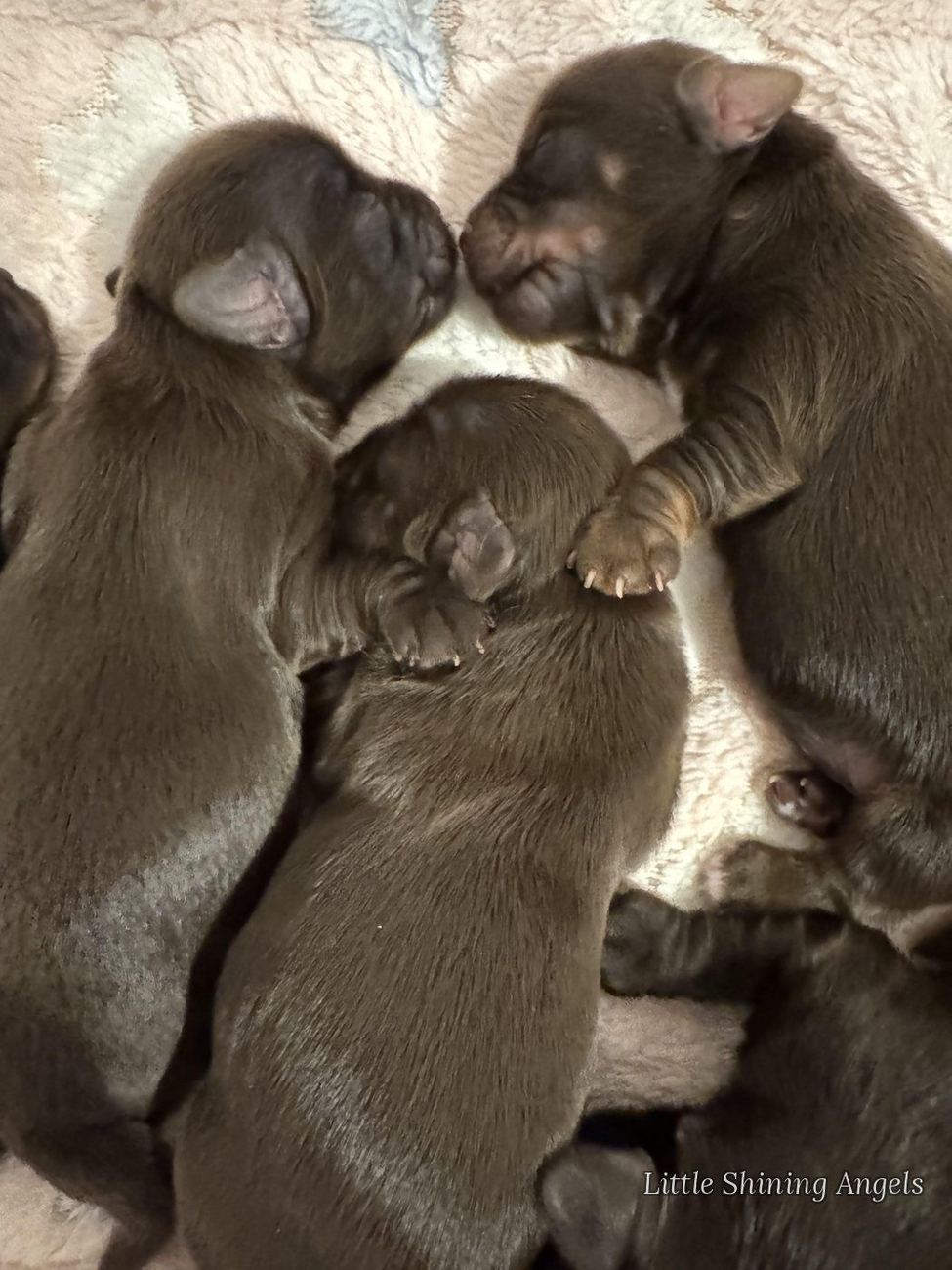
There is a period in a puppy's life that lasts only a few weeks but leaves a mark for life. This is when the little mind opens to the world and learns whether it is friendly or not.
This period begins somewhere around three weeks and slowly closes around three months. During this time a puppy learns far more easily than later that people are good, that noise is not dangerous, and that a new thing is not a reason for fear but for curiosity.
We like to say that a few weeks of kind experiences during this time are worth more than years of effort later. That is why we leave these weeks to nothing by chance.
They get to know the world slowly and calmly
Our puppies do not grow up in a cage but in our living room, in the middle of everyday life. They hear the vacuum cleaner, the doorbell, dishes in the kitchen, footsteps. They hear all of this while still small enough to accept it as a perfectly ordinary part of the world.
They also get to know touch. Every day we gently take them in our hands, stroke them, touch their paws and ears. Not to teach them anything complicated, but so that the human hand becomes something warm and familiar. Later, when it is time to trim nails or visit the vet, the dog is not afraid, because hands have only ever stroked it.
But it is important that all of this goes slowly. Too many new things at once can overwhelm a puppy and achieve the opposite of what we want. So we pay attention to each one. Some are braver, others need more time. We let each keep its own rhythm.
We reward what we want to see
Our approach to raising is simple. We teach the dog what we want and reward it for that. We are not so concerned with punishing mistakes as with praising the right behaviour.
When a puppy stays calm at a new sound, we praise it at once. When it approaches a new thing with curiosity, it gets a treat or play. So a simple connection forms in its little head. A new thing means something nice. And a dog that thinks this way steps into the world with trust instead of fear.
This approach builds not only obedience but a relationship. A dog that knows the nearness of a human brings pleasant things trusts us. And trust is the foundation of all that follows.
This is how we prevent fears before they arise
The best thing about this approach is that it prevents most problems before they even appear. Excessive barking, fear of visitors, panic at noise. All of this often grows from early unpleasant experiences. But if a puppy experiences these same things from an early age as something calm and pleasant, fear simply has nowhere to take root.
So we do not wait to fix problems later. We prefer to make sure from the start that they do not arise. This is immeasurably easier for the dog, and for the family that welcomes it.
When a puppy leaves us for a new home, we always tell the new owners to continue this. The first weeks with them are just as precious. And we are happy to advise on how to go on.
References and sources
Scott JP, Fuller JL (1965). Genetics and the Social Behavior of the Dog. University of Chicago Press.
Freedman DG, King JA, Elliot O (1961). Critical period in the social development of dogs. Science 133(3457):1016–1017.
American Veterinary Society of Animal Behavior (2008). Position Statement on Puppy Socialization.